
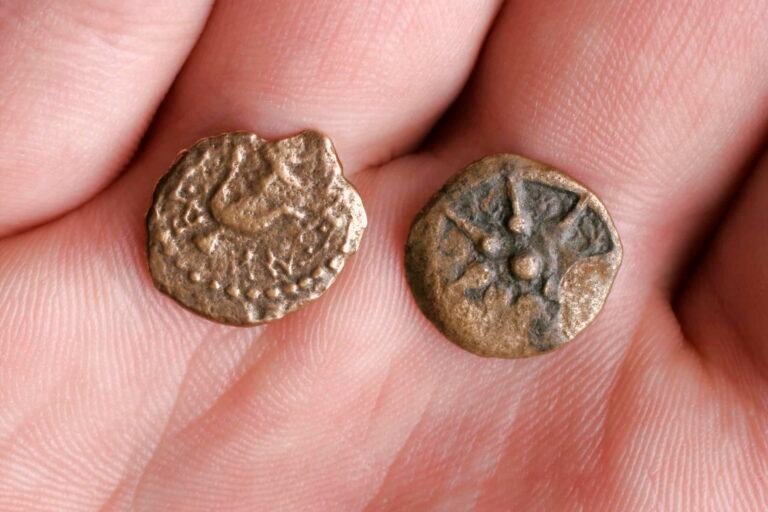
readers familiar with the gospel You can know the story of the widow mite. This story is related in both Mark 12:41-44 and Luke 21:1-4. In it Jesus praises the generosity of a widow who gave her all, even though the financial value of her contribution was not great. If you’ve ever wondered what Widow’s Coins were and what they were worth, read on.
Luke’s gospel account of the widow’s mite
The gospel writer Luke tells the story Like this (New King James Version):
“And he looked up and saw the rich putting their gifts into the treasury, and he also saw a poor widow putting in two coins. He said, ‘Truly I tell you, this poor widow has put in more than all of them; for out of their abundance all have put in a gift to God, but out of her poverty she put in all her living.'”
Clearly, the Biblical point of this story is to demonstrate the value of generosity, even if the amount is small. This means that God does not value things the way humans do. The rich people in the story give far more, but they are not appreciated because their gifts are not sacrifices. In contrast, the widow made her sacrifice with faith and care, and she is remembered by history.
How much is a mite?
Perhaps a better question is: What was the mite? In other translations of this text the words “two small copper coins, which make a penny” are substituted for the word mites. This is obviously a very small denomination coin. What types of small coins were in circulation in the Holy Land during the time of Jesus?
The Bible does not specify any type of coin. There were several small bronze coins in circulation in Judea at the time that Jesus may have been referring to. In fact, the two “mites” could have been two different types of coins.
Ancient Coin Prospects
The most likely coins would have been either Lepton or Prutot, minted under Hasmonean rulership of Judea between 135 BC and 37 BC. The common Pruta was minted during the reign of King Alexander Jannaeus. Minted in large quantities, this coin bore royal inscriptions in Hebrew and Greek, an anchor on the obverse, and an 8-pointed star on the reverse. King Alexander Xannius died in 76 BC, well before the birth of Jesus, but his coins were still freely minted.
Lepton, worth half the Prutah, was also minted by King Alexander Jannaeus. It was a small coin, smaller than the tip of a finger. In the time of Jesus, the lepton was the lowest value circulating coin. Two leptons were equal to one quadran, which was the least valuable Roman coin. One Greek silver drachma was worth 336 lepta or 168 prototes.
Another alternative to “widow’s mite” could be exotic coins such as Phoenician bronzes. The Phoenician cities of Sidon and Tire are mentioned several times in the Bible and are geographically not far from Judea.
In fact, the word mite is not a Hebrew word, but a Dutch word, meaning “small cut piece.” It came into use as early as the 14th century and became so entrenched in English usage that it was included in the King James Translation of the Bible in the 17th century.
Contemporary value of a widow’s mite
While thousands of years old, many Lepta and Prutot still exist today. However, they used to circulate freely, so most of them do not have clear specifications and cost $50 or less. Better preserved coins can be worth hundreds of dollars.
Coin collectors, history buffs, and Christians may be interested in tracking down this piece of history. If you are looking for a trusted business among coin dealers in Michigan to help you grow your own coin collection, make an appointment to speak with us by calling today. 616-884-5048. We are always happy to help people find the coins they are looking for.
!function(f,b,e,v,n,t,s){if(f.fbq)return;n=f.fbq=function(){n.callMethod?
n.callMethod.apply(n,arguments):n.queue.push(arguments)};if(!f._fbq)f._fbq=n;
n.push=n;n.loaded=!0;n.version=’2.0′;n.queue=[];t=b.createElement(e);t.async=!0;
t.src=v;s=b.getElementsByTagName(e)[0];s.parentNode.insertBefore(t,s)}(window,
document,’script’,’https://connect.facebook.net/en_US/fbevents.js’);
fbq(‘init’, ‘1690951708740874’);
fbq(‘track’, “PageView”);