
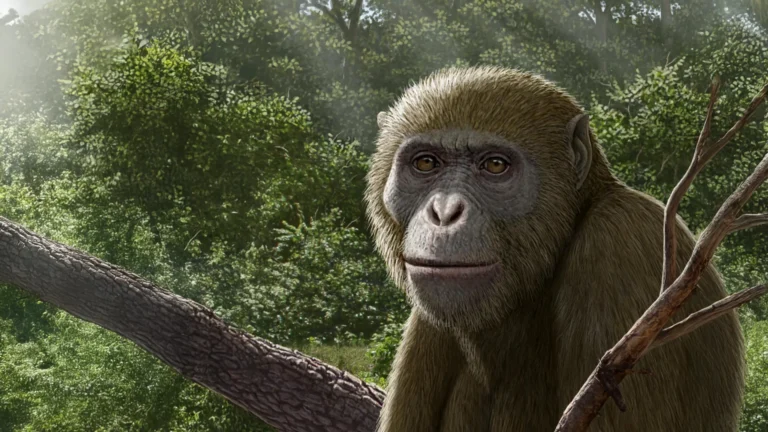
An international team of researchers has identified a previously unknown fossil ape that lived during the early Miocene, approximately 17 to 18 million years ago. species, named Masripithecus mogrensisIt was described in a study published in Science by scientists from the Mansoura University Vertebrate Paleontology Center (Egypt) and the University of Southern California (USA).
These fossils were discovered in Wadi Mogra in northern Egypt and provide the first definitive evidence of an ape from North Africa. Their age and location expand the known distribution of early apes and suggest that Egypt, along with the broader Middle East region, played a key role in the evolutionary development that ultimately gave rise to modern apes.
A missing piece in North Africa
“We spent five years searching for this kind of fossil because, when we look closely at the early ape family tree, it becomes clear that something is missing – and North Africa holds that missing piece,” said Hesham Sallam, a paleontologist at Egypt’s Mansoura University and senior author of the study.
Before this discovery, remains of monkeys had been found at early Miocene fossil sites in North Africa but no apes had been confirmed. That absence led many researchers to conclude that apes and their close relatives were largely restricted to areas of the far south of Africa at that time.
Fossils of small apes have been found in Africa, Asia, and Europe, but scientists continue to debate how these species were related and where their ancestors originated. New evidence suggests that gaps in the fossil record have distorted the history of the crown Hominoidea, the group that includes all living apes from gibbons and orangutans to gorillas, chimpanzees and humans, as well as their last common ancestor.
ape of ancient egypt
Masripithecus Turns out that apes were already living in North Africa during the early Miocene. It appears to be quite different from ape species of similar age found in East Africa.
Name Masripithecus The Arabic word for Egypt combines masr (مسر) with the Greek pithecos, meaning monkey. The species name mogrensis refers to Wadi Mogra, a fossil-rich area in northern Egypt, where members of the Sallam lab recovered the remains during fieldwork in 2023 and 2024.
Only part of the lower jaw has been found, but it contains a combination of features that were not known in any other apes of the same period. The fossil includes unusually large canine and premolar teeth, molars with rounded and strongly textured chewing surfaces, and a particularly strong jaw.
“Together, they suggest that Masripithecus Was optimized for versatility. The study interprets its chewing anatomy as evidence of a flexible, predominantly fruit-based diet, with the ability to process harder foods such as nuts or seeds when needed. This flexibility would have helped Masripithecus To thrive at a time when climate change in North Africa and Arabia was leading to more extreme weather,” said Shorouk Al-Ashkar, a researcher at the Mansoura University Vertebrate Paleontology Centre, Egypt, who was first author of the study.
New clues from the ape family tree
importance of Masripithecus This extends beyond its unusual teeth and jaw. It appears that this species also holds an important place in the evolutionary history of apes.
The researchers used advanced Bayesian methods to combine multiple types of evidence. They compared the physical characteristics of living and extinct apes, the DNA of living species, and the geological age of known fossils. This allowed them to estimate how different ape groups were related and when their evolutionary lineages diverged.
Their results indicate that Masripithecus It was more closely related to living apes than any early Miocene species currently known from East Africa.
Ape Origins May Point North
The team also conducted a biogeographic analysis to investigate where the common ancestor of all living apes likely lived. Their findings point to North Africa and the Middle East during the early Miocene.
At that time, this area held a strategically important position. The African and Arabian plates were moving northward during the final stages of collision with Asia. Changes in sea level sometimes cause marine barriers to be compressed or removed, creating temporary pathways that animals can use to move between areas.
Masripithecus Helps link previously separated fossil records of Africa and Eurasia. Its presence suggests that apes were diversifying in the region even before land connectivity opened the way for them to spread into Europe and Asia.
A long-held theory faces a challenge
Eric Seifert, a paleontologist at the University of Southern California and co-author of the study, said the findings change his view of early ape evolution.
“For my entire career, I have considered it probable that the common ancestor of all living apes lived in or around East Africa. But this new discovery, and our new and novel analyzes of hominoid phylogeny and biogeography, now strongly challenge that idea. And, importantly, the probability of this scenario does not depend on Masripithecus – But it’s consistent with this.”
Researchers hope that additional fieldwork in North Africa and the Middle East will uncover more fossils that will clarify how modern apes originated and began to diversify.
discovery of Masripithecus mogrensis It turns out that important parts of ape evolutionary history may lie buried in areas that paleontologists have not yet explored in depth.