
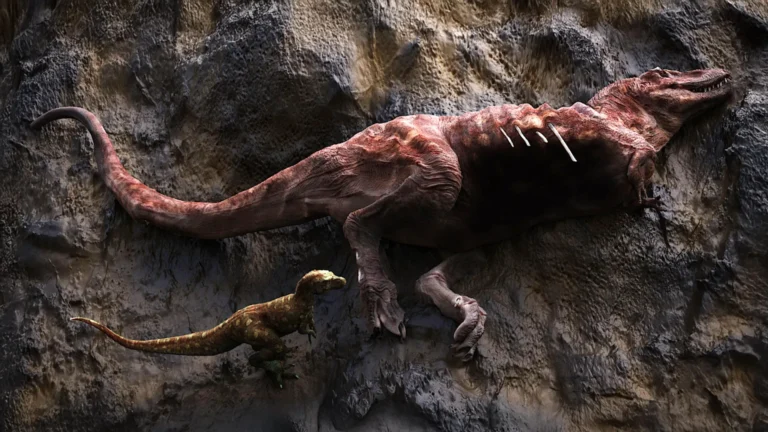
Tyrannosaurs are usually portrayed as powerful, tireless predators. However, new research shows that they also took advantage of opportunities for scavenging. When food was available, they did not hesitate to eat the remains of dead animals, even scraps.
The findings come from a study from the Department of Geology at Aarhus University recently published in the journal evolving earth.
Fossil bite marks reveal cannibalistic diet
The research was led by Josephine Nielsen, a master’s student in geology. They used advanced 3D scanning techniques to examine a fossilized metatarsal (foot bone) that belonged to a large tyrannosaur that lived more than 75 million years ago. His analysis revealed 16 different bite marks on the bone.
Josephine Nielsen says, “I analyzed the depth, angle and location of the marks in a virtual 3D environment and can document that these bite marks were not made by chance. They are the exact impressions obtained from the teeth of a small tyrannosaur eating a much larger relative.”
The results show that the tyrants did not let resources go to waste. Even hard bones with less flesh were eaten away late in the decay process, while most of the soft tissue was eaten away earlier.
She explains, “The bone shows no signs of healing after being bitten by a small dinosaur. Since the marks are located on the leg, where there is very little flesh, this suggests that the dinosaur was ‘cleaning’ and eating the last remains of an old carcass.”
Digital models help understand ancient behavior
Instead of working directly with the original fossil, Nielsen studied a digital model and a 3D-printed version created at Aarhus University.
“Of course, working with real bone must have been a special experience, but sending it to Denmark via mail is too risky,” she explains.
The metatarsal is 10 centimeters long and comes from a tyrannosaur that probably reached 10-12 meters tall and weighed several tons in life. The fossil was discovered by an amateur collector in the Judith River Formation in Montana, an area known for preserving a rich record of ecosystems dating back 75 million years. It has since been donated to the Badlands Dinosaur Museum in Dickinson, North Dakota.
Major benefits derived from the use of digital tools. The high-resolution scans allowed Nielsen to closely observe small details that would otherwise be difficult to see.
“What makes this study special is not just the knowledge of how the food chain worked among dinosaurs millions of years ago, but the technology used to read the details. By creating a digital version, I am able to zoom in on very small details. To ensure that the analysis was objective, I used the systematic CM (category-modifier) classification system. This method classifies each individual mark based on certain criteria, giving us information ranging from teeth strikes to deep The bite allows everything to be taken apart. It’s like solving an ancient murder mystery, with metatarsal evidence.”
Technology brings new insights into the lives of dinosaurs
Nielsen’s work was supported by Canadian paleontologist Taya Weinberg-Henzler and museum curator Denver Fowler, who served as external observers during the graduate project that led to the published study.
Josephine Nielsen says, “I came across Denver Fowler and Taya Weinberg-Heinzler while volunteering at an excavation camp in Montana in the summer of 2024. This set me on the path to my project, and making international connections while still pursuing my studies has been incredibly valuable.”
The study highlights how modern techniques can reveal detailed information about dinosaur behavior even from small marks preserved in fossils.
“We can now extract detailed information about their behavior from quite small marks. Using the CM system, we have established a common scientific language to describe bite marks. This means we are no longer just guessing ‘this is what a bite looks like,’ but can document precisely when and why the smaller tyrannosaur sank its teeth into the larger one,” says Josephine Nielsen.