
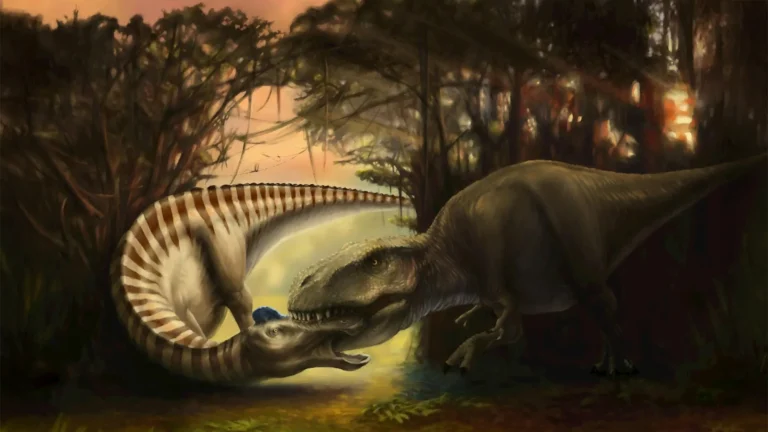
A remarkable fossil at Montana State University’s Museum of the Rockies is giving scientists an unusually detailed glimpse of how Tyrannosaurus might have attacked its prey. The specimen, which contains a tyrannosaur tooth still embedded in the skull of another dinosaur, is the focus of a new study by researchers at Montana State University and the University of Alberta in Canada.
About 66 million years ago, near the end of the age of dinosaurs, Tyrannosaurus ruled what is now Montana. The giant predator shared its environment with other giants, including the horned Triceratops and the duck-billed herbivorous Edmontosaurus.
Embedded Tyrannosaurus Tooth Tells an Ancient Story
In 2005, researchers discovered a nearly complete Edmontosaurus skull in the Hell Creek Formation of eastern Montana on land managed by the Bureau of Land Management. The fossil is now part of the Paleontology Collection of the Museum of the Rockies, where one extraordinary feature immediately stands out: a broken Tyrannosaurus tooth embedded in the animal’s face.
The skull is currently on display in the museum’s Hall of Horns and Teeth and has become the focus of a collaborative investigation led by University of Alberta doctoral student Taiya Weinberg-Henzler and John Scannella, curator of paleontology at the Museum of the Rockies. Their findings were published in the scientific journal PeerJ.
“Although bite marks on bones are relatively common, finding a embedded tooth is extremely rare,” Vayenberg-Henzler said. “The best thing about a embedded tooth, especially in the skull, is that it not only lets you identify who was bitten, but also tells you who did the biting. This allowed us to paint a picture of what happened to this Edmontosaurus, much like Cretaceous crime scene investigators do.”
CT scan helps to reconstruct the attack
To identify the predator, the researchers compared the embedded tooth to every known meat-eating dinosaur from the Hell Creek Formation. The match pointed towards Tyrannosaurus. A CT scan performed at Advanced Medical Imaging at Bozeman Health Deaconess Hospital provided additional information about how the tooth became lodged in the skull.
“This kind of fossil is extra exciting because it shows a behavior: a tyrannosaur biting the face of this duckbill,” Scannella said. “The skull shows no signs of healing around the tyrannosaur teeth, so it may have already been dead when it was bitten, or it may have died as a result of being bitten.”
Rare fossil provides new clues about Tyrannosaurus behavior
According to Wyenberg-Henzler, the condition of the teeth provides important clues about the encounter between predator and prey.
“Looking at the way the tooth embedded itself in the nose of Edmontosaurus suggests that it met its attacker face-to-face, something that typically happens with an animal killed by a hunter,” Weinberg-Heinzler said. “The amount of force required to break a tooth also points to the use of lethal force. To me, it paints a horrifying picture of the final moments of this Edmontosaurus.”
Scientists have debated the feeding habits and hunting behavior of Tyrannosaurus for decades. As one of the largest meat-eating animals to ever live on Earth, it has long been the focus of paleontology research. This rare fossil, whose embedded teeth have been preserved for millions of years, provides further valuable evidence about how the iconic hunter might have hunted and tamed its prey.