
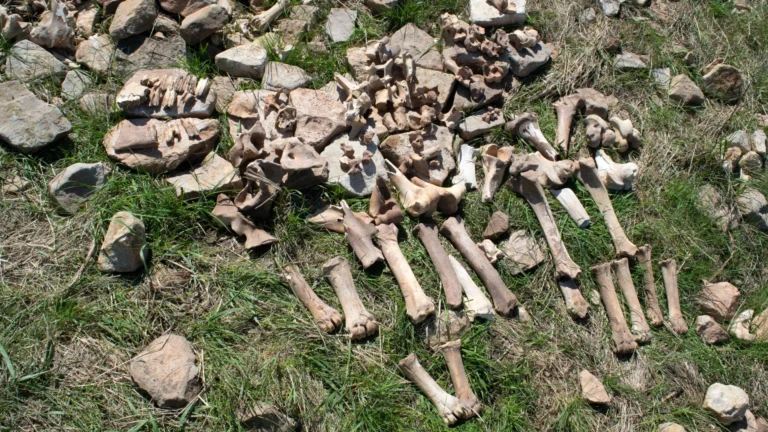
For thousands of years, bison roamed the Great Plains of North America and were an essential resource for indigenous hunters. Those hunting traditions continued until the late 1800s, when overhunting drove the bison population to the brink of extinction. However, long before that decline, hunters relied on a variety of strategies and locations to harvest bison, sometimes moving from one site to another.
A new study examines why hunters stopped using a particular location in central Montana, known as the Bergstrom Site. Although bison remained abundant in the area, the site was used intermittently for about 700 years before it was eventually abandoned. The findings were published in Frontiers in Conservation Science.
“We found that bison hunters stopped using a kill site in central Montana about 1,100 years ago,” said first author Dr. John Wendt, a paleontologist and assistant professor of rangeland ecosystem management at New Mexico State University. “It appears that hunters stopped using it because severe, recurring droughts reduced the water available for processing animals in a nearby small creek. Abandonment of the site was a response to environmental stress and changing social and economic pressures.”
Investigating an ancient bison hunting mystery
To determine what factors influenced hunting decisions at the Bergstrom site, researchers combined archaeological excavation with environmental analysis. His work included sediment resection, laboratory testing, climate reconstructions, and study of past plant and animal activity.
“The Bergstrom site presented a puzzle because it was used intermittently and was abandoned when bison were common throughout the region and hunting was intense,” Wendt explained. “Why would hunters stop using a site that had been working for so long?”
In spring 2019, the team dug nine 1×1 meter test pits at the site. Artefacts and other materials were documented and photographed, while charcoal samples were submitted for radiocarbon dating. The researchers also collected two sediment cores from near the excavation area and analyzed them for pollen and charcoal. Additional data on large herbivores and historical climatic conditions helped the team evaluate whether environmental changes or other factors contributed to the site’s abandonment.
The results ruled out several possible explanations.
Wendt explained, “Abandonment did not occur because the site had become ecologically unsuitable in any absolute sense. Bison were still around, vegetation had not changed, and there was no significant change in fire activity.” “Bison hunting activity was not simply following the prey population.”
Drought and changing hunting strategies
Instead, the evidence points to repeated severe droughts that affected the region before and after the site’s final abandonment. These prolonged dry periods reduced water availability and made places without reliable water sources less attractive for large-scale hunting activities.
Around the same time, hunting practices were evolving. Small, mobile groups that hunted opportunistically were increasingly being replaced by larger, more coordinated groups. These large operations often depended on built-up infrastructure and occupied few locations for long periods.
“These larger operations were based on large-scale kills and could generate surpluses for trade and winter storage, but they also meant greater reliance on specific resources such as water, fodder for large herds, and fuel for fire processing,” Wendt said.
As these larger hunting efforts required more resources, finding suitable locations became difficult. Ideal sites require reliable access to water and other necessities as well as landscape features that can help manage and control bison herds. The rocks used for bison jumps and natural obstacles were especially valuable. Once such places were established, they were often used repeatedly for centuries.
Lessons in Climate Adaptation
While larger hunting grounds offered advantages, they also increased dependence on favorable conditions. These specific locations were difficult to change, making hunter-gatherer groups more vulnerable when key resources became scarce.
Researchers believe that long-term success depends on the ability to adapt. Hunting communities transferred knowledge from generation to generation and adjusted their strategies as environmental conditions changed. According to the team, that flexibility helped these systems tolerate periods of climate instability.
The findings may still have relevance today. Modern bison management programs can improve their resilience to changing environmental conditions while maintaining the ability to adjust where and how the animals are managed.
The researchers noted that other abandoned bison hunting sites in the area may have been left behind for different reasons. He also emphasized that while the study documents nearly 700 years of use at Bergstrom, it cannot determine how long individual occupation periods lasted or how often the site was used during that time. Furthermore, abandonment may sometimes be followed by low-impact use without leaving evidence that can be detected archaeologically.
Wendt concluded, “While people have been adapting to climate for a long time, Bergström’s abandonment shows that people have reorganized in response to recurring droughts over the past 2,000 years.”