
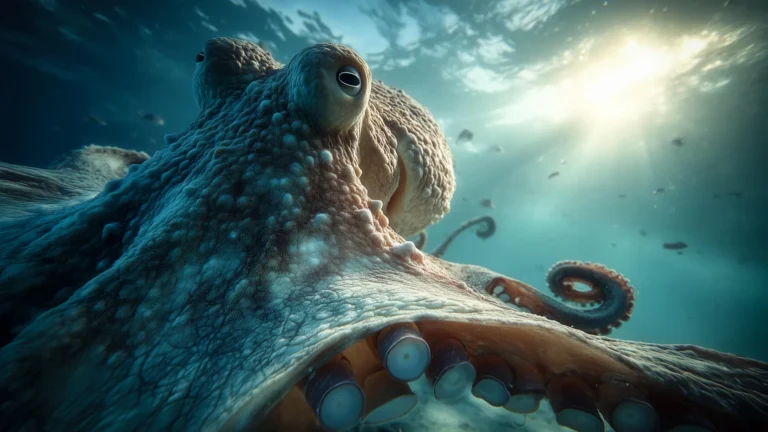
Modern octopuses are known for their intelligence and flexibility, slipping through tight spaces, hiding in rocks, or drifting in the deep sea. However, new research shows that their distant ancestors lived very differently. Scientists now believe that early octopuses were not quiet, elusive creatures, but rather massive predators that hunted large vertebrates as well as those at the top of the marine food chain. The study, led by researchers at Hokkaido University, was published Science On April 23, 2026.
Tracing the origins of octopuses has long been difficult because their soft bodies rarely fossilize. Unlike animals with bones or armor, they leave little physical evidence. To overcome this, researchers focused on fossilized jaws, a body part that is more likely to survive for millions of years, to look for clues about their early evolution.
Using high-resolution grinding tomography combined with an artificial intelligence model, the team discovered fossilized jaws within rock samples from the Late Cretaceous period, between 100 and 72 million years ago. These fossils were recovered from sites in Japan and Vancouver Island, where cool seafloor conditions helped preserve delicate details. Fine wear marks on the jaws provide valuable information about how these ancient animals fed.
Evidence of powerful predatory behavior
The fossils belonged to an extinct group of winged octopuses known as Cerata. By studying the size, shape, and surface wear of the jaws, researchers determined that these animals were active predators capable of crushing small prey with a strong bite.
“Our findings show that early octopuses were giant predators that occupied the top of the marine food chain in the Cretaceous,” says Professor Yasuhiro Iba of Hokkaido University. “Based on exceptionally well-preserved fossil jaws, we show that these animals reached a total length of up to about 20 metres, which may have exceeded the size of large marine reptiles of the same age.”
“The most surprising finding was probably the extent of wear on the jaw,” says Iba. The jaws of the fossil revealed extensive chipping, scratching, breakage, and polishing, all signs of strong biting forces. “In well-grown specimens, 10% of the jaw tip was eroded relative to total jaw length, which is larger than seen in modern cephalopods that feed on hard-shelled prey. This indicates repeated, vigorous interactions with their prey, revealing an unexpectedly aggressive feeding strategy.” These observations point to highly active predators that regularly consume tough, abundant prey.
Pushing back the origins of the octopus
The discovery significantly reshapes what scientists think about early octopus evolution. The fossils extend the oldest known record of winged octopuses to about 15 million years and push the broader octopus timeline back by about 5 million years. This places their origin about 100 million years ago.
Another notable detail came from the uneven wear patterns on the jaws. In the two species studied, one side of the cutting surface showed more wear than the other. This suggests that the animals may have preferred one side of their jaws, a behavior known as lateralization. In modern animals, lateralization is associated with advanced brain function. The findings raise the possibility that these early octopuses also displayed complex, intelligence-related behavior.
Rethinking ancient oceanic food chains.
For many years, scientists have viewed ancient marine ecosystems as dominated by vertebrate predators, with invertebrates playing a minor role. This research challenges that notion. Evidence suggests that giant octopuses were an exception, rising to the top levels of the food web and competing directly with larger vertebrates.
“This study provides the first direct evidence that invertebrates could evolve into giant, intelligent apex predators in ecosystems that have been dominated by vertebrates for about 400 million years. Our findings show that the loss of powerful jaws and superficial skeletons, common features of octopuses and marine vertebrates, were necessary to become giant, intelligent marine predators,” says Iba.
Unlocking ancient ecosystems with AI
The study also highlights the potential of combining digital fossil-mining techniques with artificial intelligence. This approach could help scientists uncover many more hidden fossils and reconstruct ancient ecosystems in far more detail than before.