
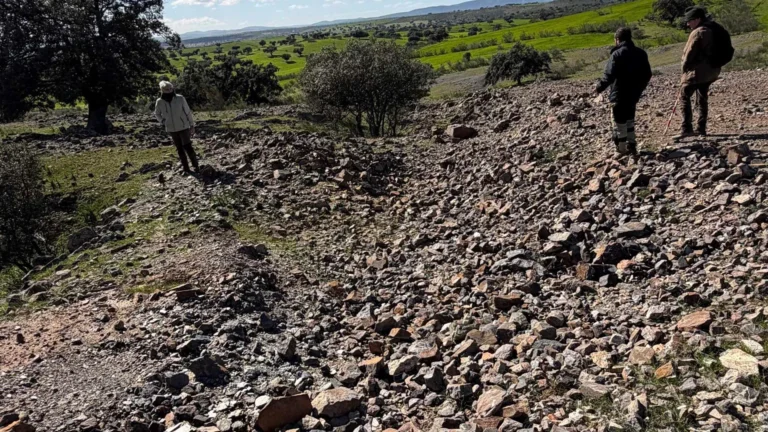
Archaeologists have discovered six previously unknown Bronze Age mining sites in Extremadura, south-western Spain. The discoveries were made during a survey in February led by researchers from the Marine Encounters Program at the University of Gothenburg in Sweden. These sites may help answer the long-standing question of where the metals used in Scandinavian Bronze Age artifacts originally came from.
Fieldwork took place from 9 to 16 February in the area around Cabeza del Bué in the province of Badajoz. The project was carried out in partnership with experts from the Universidad de Seville and the Museo Arqueológico Provincial de Badajoz.
Researchers documented six different mining locations. These ranged from small extraction areas to larger, more complex sites. One location led to the discovery of approximately 80 corrugated stone axes, which were used to break and process the ore.
Copper, lead and silver point to ancient trade
Mines included copper, lead and silver, all of which played important roles in Bronze Age economies. These materials were widely traded over long distances, becoming the backbone of early European exchange networks.
The investigation builds on earlier work involving the Maritime Encounters program and other archaeological projects led by Professor Johan Ling at the University of Gothenburg. Previous studies using lead isotopes and chemical analysis of Scandinavian Bronze Age artefacts have shown that most of their metal originated in south-western Spain.
Evidence of a connected Bronze Age Europe
“Newly discovered Bronze Age mines identified over the past ten years – both by other research teams and through nearly 20 new mines documented by our research group between 2024 and 2026 – are changing our understanding of how connected Europe was as early as 3,000 years ago. These discoveries demonstrate that metal extraction in southwestern Europe was far more widespread and systematic than previously recognized, and they are supported by chemical and isotopic analyses. provide a solid archaeological context that points to long-distance connections during the Bronze Age, says Professor of Archeology Johan Ling.
Facts/Extremadura Survey
- Location: Area around Cabeza del Bué, Province of Badajoz, Spain
- Date: 9-16 February
- Project: Marine Encounter
- Partners: Universidad de Seville and Museo Arqueológico Provincial de Badajoz
- Results: Six previously unregistered Bronze Age mines
- Notable discovery: About 80 corrugated stone axes used for ore processing
- Metals: Copper, Lead and Silver