
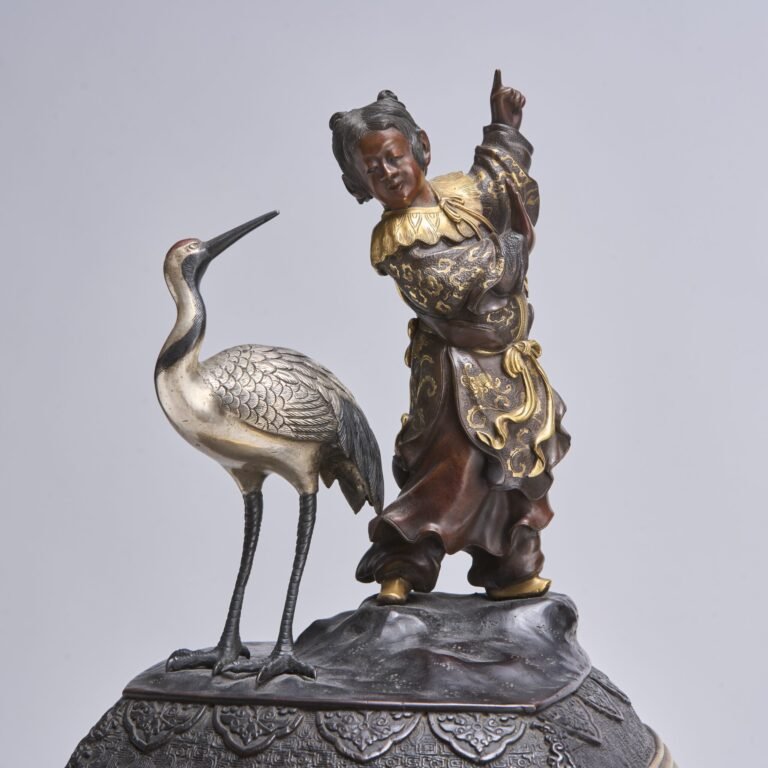
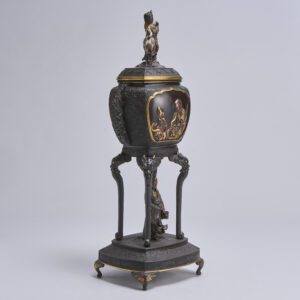
Our featured artwork for the month of May is this extraordinary, exhibition-quality Japanese bronze and multimetal koro, a stunning example of the technical ingenuity, symbolism, and artistic ambition of the Japanese Meiji-era.
As always with our articles and stories, you can click on any particular image for a closer look.
In this blog, we’ll look at the techniques, materials, cultural symbolism, and mythology behind this statement from the late 19th Century craftsmanship, but first..
What is Koro?
Simply put, koro is a Japanese incense stick. Traditionally used in Buddhist rituals, ceremonial settings, and lavish interiors, the simple incense burner evolved into a much more elaborate form during the reign of Emperor Meiji.
Japanese artists and workshops under the direction of Meiji (1868–1912) were tasked with creating works of art to capture the imagination and interest of the rest of the world and so the koro created during this time were rarely modest in design. This piece is no exception.
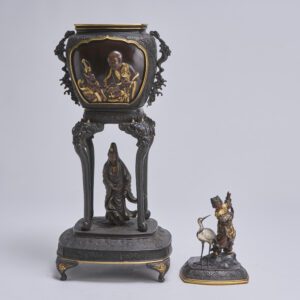
Executed in painted bronze with gilt and mixed-metal decoration, this monumental (90 cm height) incense burner consists of three main sections.
Stand and Base:
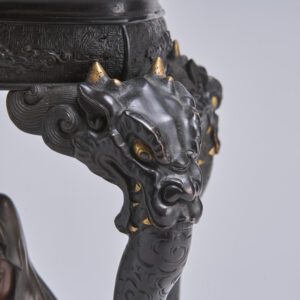
The ship rests on four, long, curved legs, each with a dragon-like Oni head at the top. Each mythological beast has legs emerging from its mouth that give the effect of four long terrifying tongues reaching to the base.
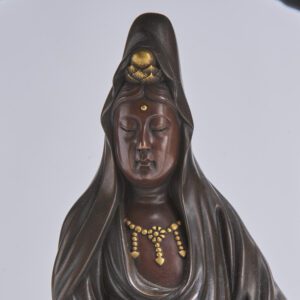
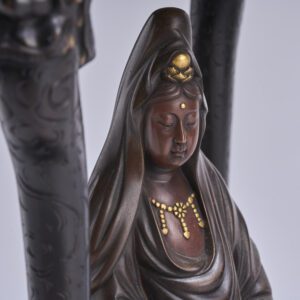
Within this open structure stands a serene bronze statue of Kannan (Bodhisattva of Compassion), his robes blowing gently in the wind. She forms the circle “Mudra” with both her hands symbolizing great knowledge. In itself, this majestic figure is an impressive and beautifully rendered okimono.
At the bottom of the koro is an oval base decorated with archaic-style surface texture and gilt accents on the feet.
Central Vessel:
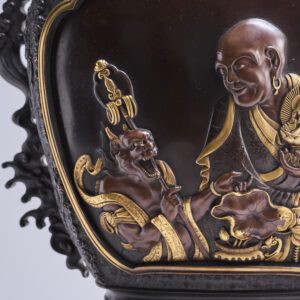
The bulbous body has high-relief multimetal decoration in shakudo, shibuichi and gilt bronze. A peach-shaped panel on the front depicts a Buddhist monk with an oni attendant. The monk holds a small shrine in one hand and a rosary of prayer beads in the other, while the dutiful oni carries the monk’s khakkhara staff.
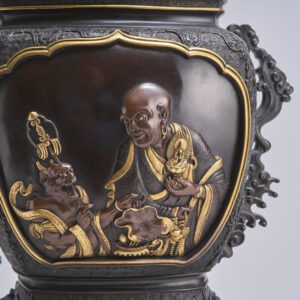
Symbolizing the balance between inner peace and outer power, monks and oni are often seen representing overcoming chaotic forces by enlightened wisdom.
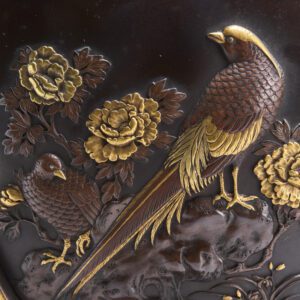
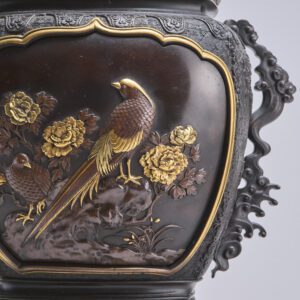
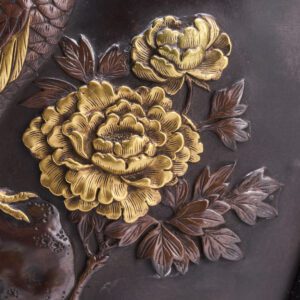
Behind the central vessel is a panel of similar skill and rendering depicting a pair of pheasants amidst flowering peonies, (itself a symbol of longevity and unity.)
On the sides are ornate, stylized crashing waves representing divine power and resistance.
Lid and final:
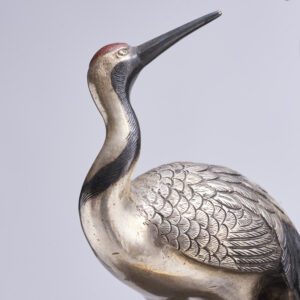
The domed cover is decorated with archaic floral motifs, textured with a geometric stamp and bordered with gilt bands. Like Kannon’s portrayal, Finial can also stand alone as an impressive okimono in its own right. It is in the form of a finely carved figure of a small child accompanied by a red crowned crane.
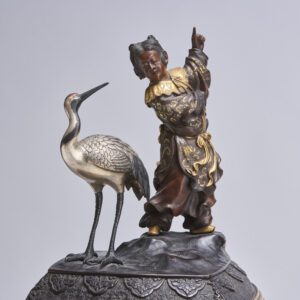
The child points up towards the sky as if gesturing and asking the crane why it is not flying. In Japan, the crane is a symbol of longevity and auspiciousness. Here it is presented with elegant naturalism, in contrast to the child’s animated pose.
Overall, Koro successfully combines many different and seemingly unrelated elements into one, very impressive example of Meiji-era metallurgy. The overall theme seems to be about a balance between nature and spirituality.
Although unsigned, it has been attributed to the Miao Company. Miyao was one of the most famous metalworking studios of the Meiji-era, founded by Miyao Eisuke in Yokohama before relocating to Tokyo in 1890. The company was renowned for producing high quality, decorative bronze sculptures and mixed-metal masterpieces, with their art works exhibited at many major international exhibitions. You can view a selection of signed works of the Miyao Company from our collection of Japanese metalwork click here.
This type of koro, which displays the enviable and unique skill possessed by the Japanese at the time, would likely have been made for display at one of these exhibitions. Smaller, similar examples would be available for general purchase, but larger examples like this are often found in larger estates or museums.
We hope you found this article interesting. You can find 150 blog posts and stories inspired by our collection of Chinese and Japanese fine art and antiques click here.