
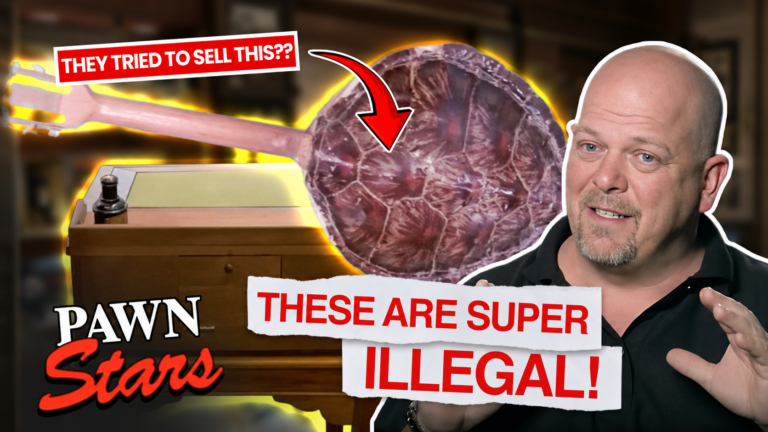
At the World Famous Gold & Silver Pawn Shop in Las Vegas, we gonna see the Pawn Stars Illegal Items, the atmosphere is often electric with the possibility of a five-figure score. However, beneath the neon lights and the clack of antique slot machines lies a minefield of federal regulations that can turn a “great buy” into a legal catastrophe. For Rick Harrison and his team, a single mistake involving Pawn Stars illegal items can lead to more than just a financial loss; it can result in a $10,000 fine, the permanent forfeiture of a dealer’s license, or even a prison sentence.
The reality of the high-end collectibles market is that many items occupy a “legal gray area” where the line between a historic artifact and a contraband weapon is razor-thin. Collectors often unknowingly possess items that violate the National Firearms Act (NFA), the Endangered Species Act, or international treaties governing the sale of stolen cultural property. If you are a serious investor in rare goods, you must understand that ignorance is never a valid defense in the eyes of the law.
This guide explores the most high-stakes cases of Pawn Stars illegal items to ever cross the counter at Gold & Silver. By dissecting these transactions through the lens of federal law and expert due diligence, you will learn the critical “red flags” that separate a legendary find from a dangerous liability. Whether you are hunting for antique weaponry or biblical artifacts, mastering these five secrets is essential for protecting your freedom and your fortune.
- The 1898 Antique Cut-off: Federal law (the Gun Control Act of 1968) dictates that only firearms manufactured in or before 1898 are considered “antiques” exempt from ATF registration.
- Biological Contraband: The 1973 Endangered Species Act and CITES treaty make the commercial trade of post-1970s tortoise shell and other protected materials a federal felony punishable by massive fines and house arrest.
- The Identity Litmus Test: Any item with a removed, altered, or “scrubbed” serial number or engraving is legally classified as stolen property in the pawn industry, regardless of its actual origin.
The James Bond Desk Gun: Navigating the 1898 Antique Rule
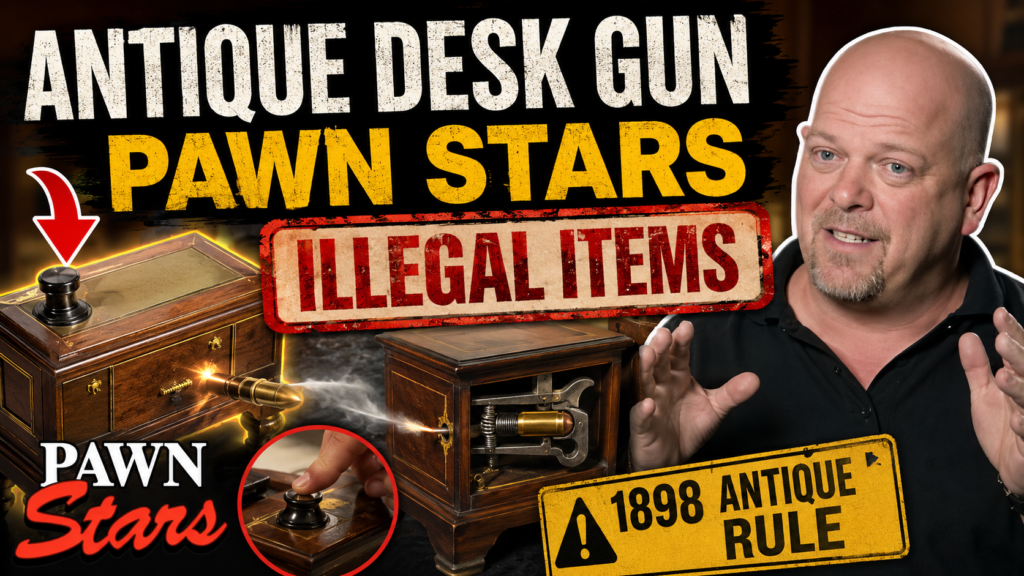
One of the most visually stunning items to ever grace the shop was an ornate, miniature wooden desk that functioned as a concealed weapon. Straight out of a 1960s spy thriller, this “gun desk” featured a hidden firing mechanism where pushing down on a functional inkwell would trigger a hammer to strike a .22 short caliber bullet. The projectile would then fire through a small trap door in the front of the desk, effectively turning a piece of office furniture into a lethal trap.
While the “cool factor” of this item was off the charts, it presented an immediate legal crisis for the shop. In the United States, the Gun Control Act of 1968 (GCA) establishes a clear line of demarcation for what constitutes a “firearm” versus an “antique.” If a weapon was manufactured in 1898 or earlier, it is generally exempt from the strict registration requirements of the Bureau of Alcohol, Tobacco, Firearms and Explosives (ATF). If it was made in 1899 or later, it is a modern firearm requiring a Federal Firearms License (FFL) for transfer.
The desk gun occupied an even more dangerous sub-category under the National Firearms Act of 1934: “Any Other Weapon” (AOW). Because the gun was disguised as something else (a desk) and lacked a traditional barrel to provide back pressure or rifling, it was a high-risk concealed weapon. Expert Sean Rich noted that while the patent markings suggested an era between 1890 and 1910, the inability to prove a pre-1898 manufacture date made the item “toxic” for a standard pawn transaction.
To navigate these “Curios and Relics” laws, a collector must adhere to two strict protocols:
- Forensic Age Verification: You must find a manufacturer’s mark or a clear patent date that proves the 1898 cutoff; without this, the ATF defaults to classifying the item as a modern (and potentially illegal) firearm.
- Professional Deactivation: If the age cannot be verified, the only way to legally trade the item as a “novelty” is to have a certified gunsmith permanently disable the firing pin or weld the chamber, rendering it a non-firearm.
The Forbidden Chords: Why This Tortoise Shell Guitar is a Legal Minefield
When a seller brought in a guitar constructed from the actual shell of a sea turtle, it highlighted one of the most severe biological risks in the collectibles world. The instrument featured a striking orange and brown pattern that was once highly prized in the Victorian era for combs, jewelry, and high-end guitar picks. However, the beauty of the material masks a federal felony: the illegal trade of endangered species parts.
The global community effectively ended the commercial trade of tortoise shell in the early 1970s through the CITES (Convention on International Trade in Endangered Species) treaty. In the United States, the Endangered Species Act of 1973 provides the teeth for this ban. Even if you “found” the item or bought it at an estate sale, the act of selling it across state lines or in a commercial setting without proper “pre-ban” certification can trigger life-altering penalties.
The legal stakes for this specific piece of Pawn Stars illegal items history were described in harrowing detail by the shop’s experts. Trading in such items can lead to ten months of house arrest and fines exceeding $20,000. This is because the law places the “burden of proof” on the owner; if you cannot prove through carbon dating or historical documentation that the item predates the 1970s ban, the government assumes it is illegal contraband.
“A bald eagle feather is a ten thousand dollar fine… ignorance is no excuse for the law.” — Expert Warning from Gold & Silver Pawn.
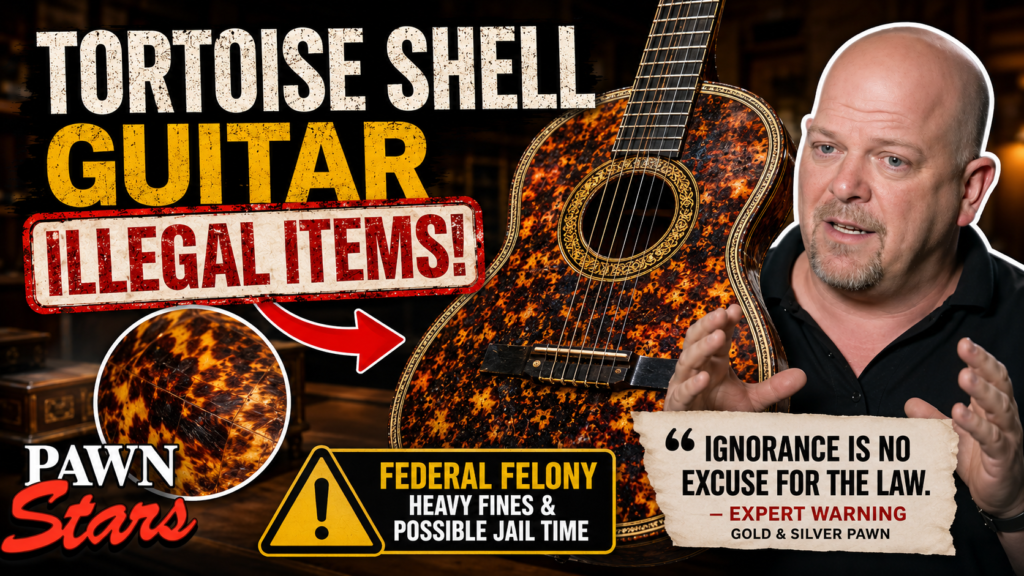
The guitar featured intricate rosetta patterns and binding that suggested it was a masterpiece of lutherie, likely brought back by a soldier from the Pacific theater after World War II. Despite its historical value, Rick Harrison’s refusal to “touch it with a 10-foot pole” serves as a masterclass in risk management. In the modern market, biological items like ivory, tortoise shell, and certain migratory bird feathers are considered “dead assets” that can never be legally liquidated without a mountain of paperwork.
The “No-Go” Zone: The Peril of Scratched Serial Numbers and Scrubbed Names
In the world of professional pawn and high-end collectibles, an item’s “identity” is its most important legal feature. When that identity is intentionally obscured, the item becomes legally radioactive. This was demonstrated through two distinct items: a 1950s Minox spy camera and a 1973 Penn State Orange Bowl championship ring.
The 1950s Minox Spy Camera
The Minox camera, famously used by actual intelligence agencies during the Cold War, was roughly the size of a cigarette lighter. While these are popular with photography enthusiasts, the unit brought into the shop carried two major red flags. First, it had a name (“Bill McCord”) and a social security number carved into the metal—a common practice in the 1950s for theft prevention. Second, a different engraving on the body had been crudely scratched off.
From a law enforcement perspective, a scratched-off serial number or identifying mark is the universal signifier of stolen property. Rick explained that entering such an item into the shop’s reporting system would trigger an immediate police investigation. Even if the current seller didn’t steal it, the law treats any item with a removed serial number as contraband that cannot be legally bought, sold, or even possessed by a dealer.
The 1973 Penn State Orange Bowl Ring
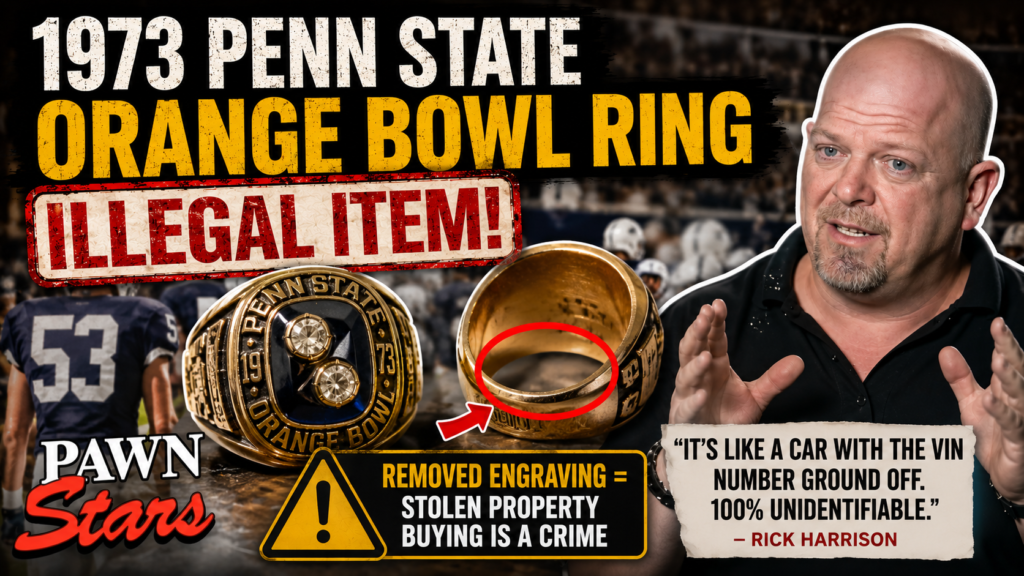
The championship ring belonging to former linebacker Jeff Clark represented a piece of undefeated college football history. However, the player’s name had been professionally removed from the inside of the gold band. Rick utilized a “VIN number” analogy to explain the legal hurdle: just as it is illegal to sell a car with a ground-off Vehicle Identification Number, it is illegal to trade a high-value commemorative item where the unique identifier has been erased.
Removing an engraving makes an item “100% unidentifiable,” which is the primary tactic used by thieves to move stolen jewelry through the secondary market. For a collector, buying an item with a “scrubbed” identity is a guaranteed way to lose your entire investment when the item is eventually seized by authorities.
Biblical History vs. Modern Security: The Stolen Shekel of Tyre
The case of the Shekel of Tyre illustrates the concept of “Legal Title”—the right to own an object. This ancient coin, known as the “30 pieces of silver” paid to Judas in the Bible, was struck over 2,000 years ago using a four-foot hammer strike process. Because these coins were handmade, no two are identical, making them uniquely identifiable to experts and national databases.
After Rick purchased the coin for $1,600, the shop’s head of security, Andy, discovered that a detective had flagged the coin in a “national computer system.” This system, similar to modern platforms like LeadsOnline, allows law enforcement to track stolen goods across state lines in real-time. The shop’s digital footprint triggered a silent alarm, and the coin was placed on a “police hold,” meaning Rick was potentially out his $1,600 investment.
The resolution of the Shekel of Tyre case provides a vital lesson in the law of property title. The coin was eventually cleared for sale because the original victim of the theft had been compensated by their insurance company. In legal terms, the “Title” to the coin passed from the victim to the insurance company, who then released the claim, making the coin “free and clear” for Rick to sell. Without this chain of title being resolved, the coin would have remained a “stolen shekel” and a total financial loss for the shop.
Expert Tip: The Collector’s “Red Flag” Checklist
To master the market and avoid the pitfalls of Pawn Stars illegal items, you must develop a systematic approach to due diligence. Use this checklist to categorize the risks of any potential acquisition:
- Chronological Risk (The 1898 Rule): For any firearm, always look for the patent date or manufacturer’s serial range. If you cannot prove it is “Antique” (pre-1898), you must treat it as a modern firearm subject to NFA and GCA regulations.
- Biological Risk (The 1970s Cut-off): Inspect any item containing organic material. If it is tortoise shell, ivory, or exotic feathers, assume it is illegal to trade unless you have certified “provenance” (a documented history) proving it was harvested before the 1973 Endangered Species Act.
- Identity Risk (The “Tool Mark” Test): Use a jeweler’s loupe to inspect areas where serial numbers or names should be. If you see signs of grinding, fresh polishing, or “ghosting” where a name used to be, walk away immediately.
- Title Risk (Database Verification): For high-value coins or art, always run the item through the National Stolen Art and Antique Database. Ensure that the “Title” is clear and that no insurance claims are pending on the object.
What makes a gun an “antique” in a pawn shop?
According to the ATF, an antique firearm is any firearm manufactured in or before 1898 that does not use rimfire or centerfire fixed ammunition (or uses ammunition no longer manufactured in the U.S.). These items are technically not “firearms” under the law and can be shipped and sold without a background check or FFL license.
Is it illegal to sell tortoise shell items?
Yes, it is generally illegal to trade sea turtle shell items commercially under the Endangered Species Act and CITES. The only exception is for “antique” items that are at least 100 years old and have documented proof of their age, but even then, many states have stricter laws that prohibit the sale entirely.
Why won’t pawn shops buy items with removed names?
Removing a name or serial number is a crime in many jurisdictions because it facilitates the “fencing” of stolen property. Pawn shops are legally required to report all identifying marks to the police; if a mark is missing, the item is considered “unidentifiable” and is treated as stolen goods by the legal system.
Conclusion
The world of rare collectibles is a high-stakes game where the “cool factor” never overrides federal law. As we have seen through the lens of Pawn Stars illegal items, the difference between a savvy investor and a criminal suspect often comes down to a single date, a missing engraving, or a forbidden material. Whether it is an 1890s desk gun or an ancient shekel, your primary job as a collector is to verify the legality of the “Title” and the “Identity” of the piece before a single dollar changes hands.
The law is the law, and in the world of high-value trade, ignorance is the fastest way to lose your investment. Always perform your due diligence, consult with experts, and never ignore a red flag just to close a deal.
Have you ever found a rare item that turned out to be too dangerous to sell? Or perhaps you’ve narrowly avoided a “legal minefield” at an auction? Leave a comment below and share your own “rare find” stories with our community of collectors!