
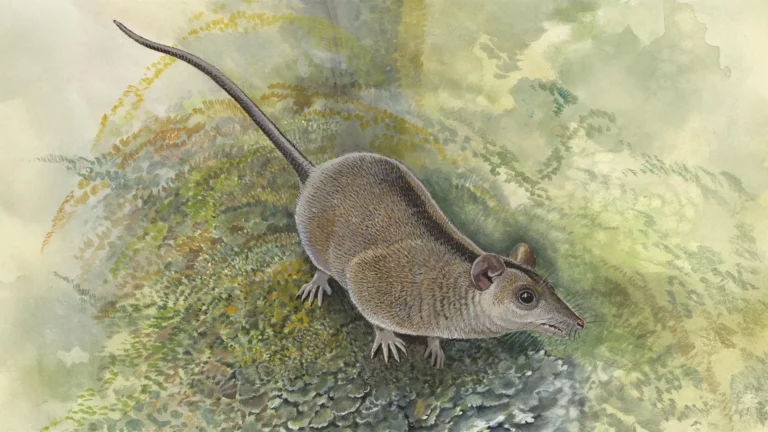
A newly identified branch of the marsupial family tree is adding a surprising twist to the history of Australia’s most distinctive mammals. The discovery suggests that their evolution was more complex and more mysterious than scientists previously understood.
Marsupials first arrived in Australia more than 55 million years ago. Since then, they have spread into an astonishing range of habitats and lifestyles. Today, they include about 160 species, ranging from High Country animals (thumb-sized possums that sleep in the winter) to the desert specialists of the Red Center, including tiny shrews with pink fur and no eyes that spend their lives underground.
Yet, despite their success, scientists still do not fully understand how marsupials diversified across Australia. Major gaps in the fossil record have left long parts of their early history virtually invisible.
Now, in a new paper published in Paleontology JournalUNSW researchers report three newly identified species that may belong to an ancient and previously unknown order of marsupials. The discovery provides a rare look at some of the earliest stages of marsupial evolution on the continent.
“Not only is this a new order, but it may also be the most ancient lineage of all Australian marsupials,” says UNSW palaeontologist Dr Tim Churchill.
“This may have been an early ancestor of all our marsupial carnivores.”
A new branch of the marsupial family tree
The standard explanation is that marsupials arrived in Australia after traveling from South America via Antarctica, before the breakup of the ancient supercontinent Gondwana.
The broad outline is widely accepted, but the details remain uncertain. Fossils dating back about 55 million years suggest that Australian marsupials may have come from a single early lineage that later split into the marsupial groups living today.
Those groups are currently classified into five orders within the superorder Australidelphia, which includes all living and extinct Australian marsupials (and one South American one).
Dr. Churchill is now proposing a sixth order, called Keunamorphia. According to their analysis, this group may have persisted for about 35 million years.
Members of Keunamorphia were probably small insectivores weighing between 25–200 g. They lived in the forests of what is now northern Queensland before disappearing about 15 million years ago.
The landscape looked very different from the dry, open country seen there today. At that time, the area was probably covered with wet, dense rainforest and supported the ancestors of many animals still alive in Australia.
“The region began to cool again about 14 million years ago,” says Dr Churchill.
“The dense forest disappears and becomes more open forest with more lakes and more grasslands.”
Fossils from Riversleigh
The three Keunamorphia species described by Dr. Churchill lived about 18 million years ago. After his death, his remains ended up in shallow cave pools, where parts of his body were now preserved in the Riversleigh World Heritage Area, one of the most important fossil sites in the world.
Complete skeletons are uncommon in the fossil record, so researchers relied on very small clues: teeth and jaw fragments. From those fragments, they worked to determine where the animals fit into the marsupial family tree.
To do this, the team combined fossil evidence with genetic information from living species. This allowed them to create a phylogenetic tree, a model that maps relationships between species and estimates how different branches diverged over time.
“What we’re essentially trying to do is create a tree that shows the relationships of all the different species in the tree, while also calculating when those branches diverged,” says Dr. Churchill.
Teeth reveal an evolutionary puzzle
The analysis showed that these three species lived alongside many other marsupials that scientists had already studied. However, their teeth were unusual, and they did not seem to be closely related to other marsupials around them.
Instead, the teeth resembled those of Jarthia murgonensis, an extinct marsupial that lived about 35 million years ago and is often seen as the prototype for Australian marsupials.
Dr. Churchill says this points to a distinct marsupial lineage that was not previously recognized. It may have become isolated early in marshy history and then survived for millions of years while other groups evolved around it.
“Whatever these things were, they seemed primitive compared to other marsupials of the time, and they seemed to be doing their job and surviving quite well along with it,” says Dr. Churchill.
Although phylogenetic trees often point to an early group that later gave rise to modern Australian marsupials, the fossil evidence appears to be less clear.
A more complex origin story
According to Dr. Churchill, the earliest members of Keunamorphia may have appeared some time after the first marsupials arrived in Australia from Antarctica about 55 million years ago.
If this is correct, Keunamorphia may represent one of the earliest marsupial orders to diverge from the main lineage. This possibility challenges the simple version of marsupial evolution, in which a single ancestral group gave rise to the entire diversity of Australian marsupials.
This also raises a surprising question. If this primitive group diverged so early, how did it survive for so long, relatively unchanged?
“The evolutionary history is much more complex than just one group that led to all of Australia’s marsupials being left behind after the continent separated from Antarctica,” says Dr Churchill.
“It’s more likely that when Australia was part of Gondwana, it was filled with all kinds of strange, primitive marsupial things, and many of them survived and led to our modern descendants.”
Diversity hidden in the fossil record
Much of that early diversity may still be missing from the scientific record. The approximately 20 million year gap in the fossil history of Australian marsupials leaves room for several lineages that have not yet been found.
Some of these ancient animals may have had common ancestors. Others may have come from different lineages that remained in Australia as the continents drifted apart.
Scientists may never be able to completely reconstruct the routes that early marsupials took as they spread and evolved. But each new fossil tooth unearthed from Australia’s ancient deposits adds another clue, making the story of marsupial evolution more complex and far richer.