
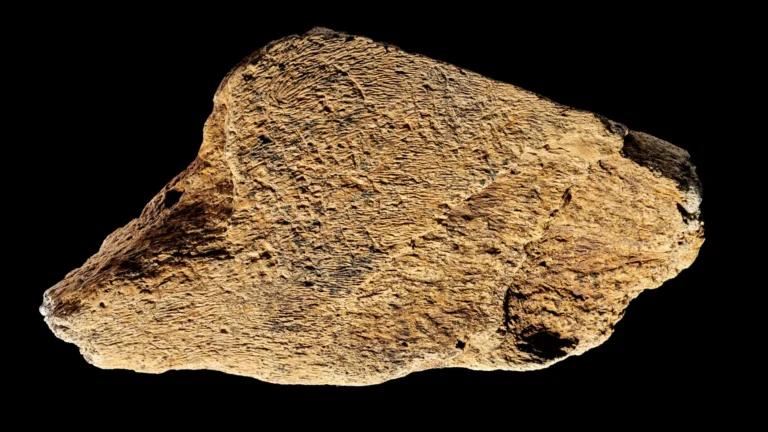
Archaeologists have identified a prehistoric hammer made of elephant bone that is approximately 500,000 years old. This object, found in southern England, is the oldest ivory tool ever discovered in Europe.
Researchers from UCL and the Natural History Museum, London analyzed the rare artefact, which provides a fascinating look at the intelligence and technological capabilities of early human ancestors. Their findings were published science advancement.
This tool was probably made by early Neanderthals or Homo heidelbergensis. Rather than functioning as a heavy hammer, it served as a soft striking tool that was used to repair and sharpen stone axes and other cutting tools after they had worn out their edges.
Lead author Simon Parfitt (Scientific Associate at the UCL Institute of Archeology and Natural History Museum) said: “This remarkable discovery demonstrates the ingenuity and resourcefulness of our ancient ancestors. They not only had a deep knowledge of the local materials around them, but also a sophisticated understanding of how to craft highly refined stone tools. Elephant bone would have been a rare but highly useful resource, and it was likely a quite valuable tool.”
500,000 year old ivory tool
The shape of the fossilized object is approximately triangular. Its length is about 11 centimeters, width is six centimeters and thickness is about three centimeters. Marks on its surface suggest that early humans deliberately shaped it to use it as a tool.
Most of the fragments consist of cortical bone, the thick and dense tissue that forms the hard outer layer of bones. Its unusual thickness suggests it came from an elephant or mammoth. However, too little of the original bone remains for researchers to identify the exact animal species or determine which part of the skeleton it came from.
This fragment was first recovered in the early 1990s. At the time, researchers did not recognize it as a device. Its true purpose only became clear when scientists recently conducted a more detailed examination of objects recovered from the site.
Subtle clues reveal its purpose
The team studied the bone with 3D scanning technology and electron microscope. Their analysis revealed distinctive marks, impact damage, and other indications that the object had been repeatedly used as a hammer.
Small pieces of flint stone were also found stuck inside the marks. These fragments provided strong evidence that bone had been used on several occasions to strike, reshape, and maintain stone tools.
Because bone is softer than stone, it allows the tool maker to work with greater precision without causing excessive damage. Early humans often used bone tools to sharpen hand axes and tools used for butchering animals.
The researchers concluded that the object probably functioned as a “rectifier”. A retoucher is used to strike the edge of a worn stone tool, removing small pieces of it to restore its desired form and cutting edge. This method of shaping the stone is known as “knapping”.
Elephant bone would have been particularly suitable for this task. Its dense outer layer was harder and more durable than many other animal bones available in the area, making it able to withstand repeated impacts.
A rare and valuable prehistoric resource
Elephants and mammoths were not common in prehistoric southern England. The decision to collect, preserve, and shape such rare material provides evidence of the resourcefulness and mental abilities of the early humans who lived there.
They appear to have understood that elephant bone offers benefits over more widely available animal bones. Instead of considering it as waste, they recognized its value and saved it for a special purpose.
The use of retouchers also points to a relatively advanced level of technology. With this equipment, early humans could produce and maintain stone tools that were more carefully shaped and complex than the tools produced by some other prehistoric populations living during the same period.
Co-author Dr. Sylvia Bello, Merit Researcher at the Natural History Museum, said: “Our ancient ancestors were sophisticated in their use of tools. Collecting and shaping a fragment of elephant bone and then using it on multiple occasions to shape and sharpen stone tools reflects an advanced level of complex thinking and abstract thinking. They were resourceful gatherers of available materials, and savvy about how to best use them.”
Boxgrove Archaeological Site
The ivory tool came from Boxgrove, an archaeological site near Chichester in West Sussex, England. Boxgrove has been excavated extensively, and researchers have discovered many tools made of flint, bone, and horn there.
However, until now, no tools made of elephant bone had been identified at the site.
Scientists don’t know whether early humans hunted the animal or collected its bones from a carcass that was already dead. The damage and distortion on the artifacts show that the bone was still relatively fresh when it was shaped and used.
An exceptionally rare European find
Elephant bone tools have previously been found in Olduvai Gorge in Tanzania, with some examples dating back 1.5 million years.
However, the discovery of ancient ivory tools in Europe is extremely unusual. Only a small number are known from 43,000 years ago, when modern humans (Homo sapiens) began to spread across the continent and made large quantities of ivory and ivory tools, artifacts, and structures.
Before this discovery, no European ivory tools were older than about 450,000 years. Most of those early examples were also found in warmer climate areas in the south.
The Boxgrove artwork therefore expands the known history and geographical range of ivory technology in Europe. It also shows that early humans in Britain hundreds of thousands of years ago were carefully selecting rare materials and using them to produce and maintain highly sophisticated tools.
The research was supported by English Heritage, UCL and the Calleva Foundation.