
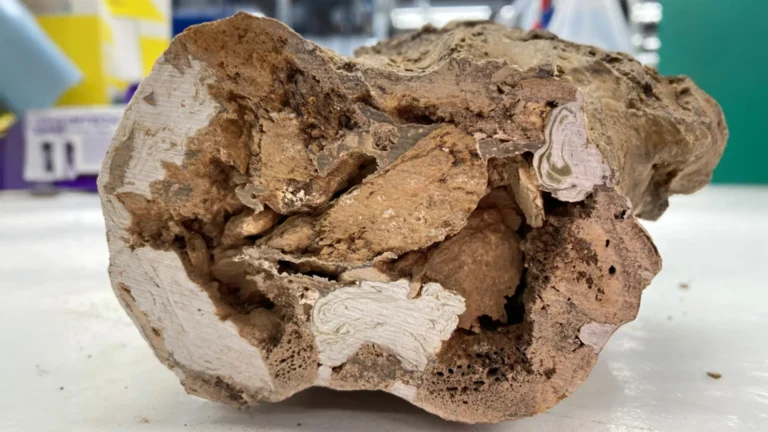
For decades, scientists believed that dinosaur fossils were little more than mineralized rock, with any original organic material eroded away over time. But an extraordinary study focused on a remarkably preserved Edmontosaurus fossil is challenging that notion in a big way.
Researchers led by the University of Liverpool discovered strong evidence that traces of original organic molecules, including collagen, are still present inside dinosaur bones dating back about 66 million years. The discovery gives powerful new support to a controversial idea that has divided paleontologists for more than 30 years.
Preserved collagen found in dinosaur bone
The fossil at the center of the study is a 22-kilogram Edmontosaurus sacrum, part of the dinosaur’s hip region, recovered from South Dakota’s famous Hell Creek Formation. Edmontosaurus was a large duck-billed plant-eater that lived alongside Tyrannosaurus rex during the late Cretaceous period.
Using a combination of advanced laboratory methods, including protein sequencing and multiple forms of mass spectrometry, scientists detected remnants of collagen embedded within the fossilized bone. Collagen is the primary structural protein found in bone tissue and is one of the most difficult biomolecules to explain in terms of contamination when identified in this context.
UCLA researchers also identified hydroxyproline, an amino acid that is strongly associated with collagen in bone. According to the team, this represents an important confirmation that degraded collagen fragments were indeed present inside the fossil.
Professor Steve Taylor, Chair of the Mass Spectrometry Research Group in the Department of Electrical Engineering and Electronics at the University of Liverpool, said:
“This research shows without a doubt that organic biomolecules, such as collagen-like proteins, appear to be present in some fossils.”
“Our results have far-reaching implications. First, it refutes the hypothesis that any organic matter found in fossils must result from contamination.”
A debate that has divided paleontology
There has been heated debate since the early 2000s over claims of soft tissues and proteins preserved in dinosaur fossils. Some scientists argued that the reported materials were modern contamination or bacterial remains rather than authentic dinosaur molecules.
One of the most famous discoveries came in 2005, when paleontologist Mary Schweitzer and colleagues reported soft tissue structures inside a Tyrannosaurus rex fossil. Later studies identified possible collagen and blood vessel-like structures in additional dinosaur specimens, including hadrosaurs related to Edmontosaurus.
The new Edmontosaurus analysis is unique because the researchers used multiple independent testing methods to examine the same fossil. By combining microscopy, chemical analysis and protein sequencing, the team aimed to eliminate contamination and strengthen the case that the molecules were native to dinosaurs.
The findings were published in analytical Chemistry in 2025 under the title “Evidence for Endogenous Collagen in Edmontosaurus Fossil Bone”.
Why does this finding matter?
If proteins can survive in fossils for millions of years, scientists may have an entirely new way to study extinct animals.
Small molecular traces can potentially reveal evolutionary relationships between dinosaur species that are difficult to identify from bones alone. Researchers can also learn more about dinosaur evolution, aging, physiology, and disease.
Taylor said scientists may now need to re-examine fossil specimens collected over the past century. Cross-polarized light microscopy images taken decades ago may contain overlooked evidence of collagen preserved in ancient bones.
Taylor explained, “These images can reveal intact patches of bone collagen, potentially offering a ready fund of fossil candidates for further protein analysis.”
“This could open up new insights about dinosaurs, for example revealing relationships between dinosaur species that remain unknown.”
mystery of molecular existence
The discovery also raises an interesting scientific question: How did these molecules survive for so long?
Proteins commonly break down over time, especially on geological time scales. Yet some fossils appear capable of preserving microbial structures under specific conditions.
Scientists are increasingly investigating whether mineral interactions inside the bone might help protect collagen fragments from complete decay. Recent studies exploring fossil biomolecules suggest that certain burial environments and microscopic bone structures can create stable conditions that dramatically slow chemical breakdown.
Edmontosaurus fossils are already renowned for their exceptional preservation. Some specimens discovered in the last century retained elaborate skin markings and other soft tissue features, earning them the nickname “dinosaur mummies”.
Recent paleontology research has continued to uncover surprisingly detailed soft tissue preservation in Edmontosaurus specimens, including evidence of muscular structures and preserved skin anatomy.
Together, these discoveries are reshaping the way scientists think about fossils. Rather than viewing them simply as stone replicas of ancient bones, researchers are beginning to view some fossils as potential molecular time capsules that preserve traces of prehistoric biology even millions of years later.