
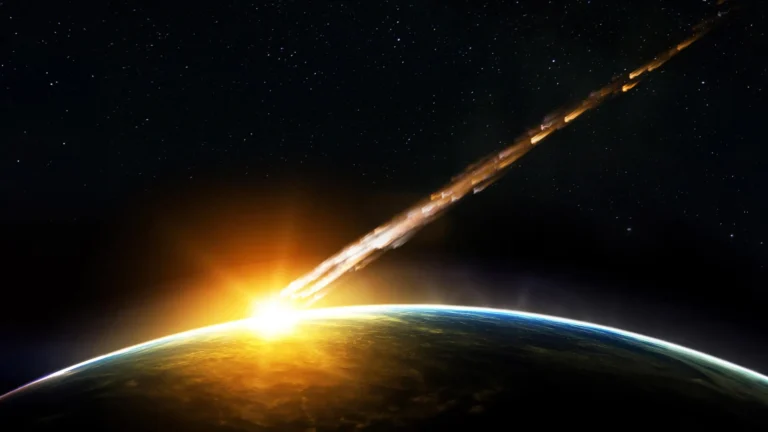
A long-running debate about a mysterious crater hidden beneath the North Sea has finally been resolved. Researchers have confirmed that Silverpit Crater was formed when an asteroid or comet struck the area about 43 to 46 million years ago.
The discovery resolves a scientific argument that has dragged on for more than two decades and identifies Silverpit as one of Earth’s relatively rare impact craters, geological scars left behind when space rocks strike the planet at tremendous speed.
The research team, led by Dr Eusdean Nicholson of Heriot-Watt University in Edinburgh and funded by the Natural Environment Research Council (NERC), has combined advanced seismic imaging, microscopic analysis of rock samples and computer simulations to make the strongest case yet for extraterrestrial impact. Their results were published in the journal nature communication.
A hidden crater under the North Sea
Silverpit Crater lies about 700 meters (2,300 ft) below the bottom of the southern North Sea, about 80 miles off the Yorkshire coast.
Since its discovery in 2002, the structure has puzzled geologists. The crater itself extends for about three kilometers (1.9 mi) and is surrounded by a much larger ring of circular faults extending for about 20 kilometers (12 mi). Faults are fractures in rock layers that form when the Earth’s crust is stressed or displaced.
Many scientists believed that Silverpit was formed by a hypervelocity impact, a term used for collisions involving asteroids or comets traveling at speeds of several miles per second. The crater’s circular shape, central peak, and surrounding distinctive fault pattern resemble features seen at known impact sites around the world.
Not everyone agreed.
Some researchers proposed that this structure formed when underground salt deposits shifted over time. Others suggested that it resulted from volcanic processes that caused part of the ocean floor to collapse.
The disagreement became so intense that geologists formally voted on the origin of the crater in 2009. According to a report in the December 2009 issue Geologist magazine, most participants rejected the impact explanation.
The latest evidence now overturns that conclusion.
New evidence reveals ancient asteroid strike
To re-examine the mystery, scientists turned to newly available seismic data. Seismic imaging works somewhat like ultrasound scans for the Earth, allowing researchers to create detailed pictures of underground rock layers using reflected sound waves.
The new images provided an unprecedented view of the crater’s internal structure.
The team also examined rock fragments collected from an oil exploration well near the site.
Dr Eusdean Nicholson, a sedimentologist at Heriot-Watt University’s School of Energy, Geoscience, Infrastructure and Society, said: “The new seismic imaging has given us an unprecedented look at the crater.
“Rare ‘shocked’ quartz and feldspar crystals were also found at the same depth of the crater floor from samples from an oil well in the area.
“We were exceptionally lucky to find these – a real ‘needle in a haystack’ effort. These prove the impact crater hypothesis beyond doubt, because they have a fabric that can only be created by extreme shock pressure.”
The rocked minerals are considered some of the strongest evidence of an asteroid impact. Microscopic structures inside these crystals form when rocks experience pressures far greater than those produced by normal geological activity.
160 meter asteroid and high tsunami
Based on the team’s analysis, the object that hit the North Sea was about 160 meters (525 ft) wide and coming from the west at a shallow angle.
Although relatively small compared to the asteroid linked to the extinction of the dinosaurs, it was still large enough to cause extraordinary destruction.
Dr Nicholson said: “Our evidence shows that an asteroid 160 meters wide hit the ocean floor at a low angle to the west.
“Within minutes, it created a 1.5 kilometer high curtain of rock and water which then fell into the sea, creating a tsunami more than 100 meters high.”
A tsunami of that size would rise more than 330 feet above sea level, taller than many modern skyscrapers.
Due to its impact, the crater was immediately dug and huge amounts of rocks, sediments and sea water were released into the atmosphere.
Discovery of the “Silver Bullet”
One of the researchers involved in the new study was Professor Gareth Collins of Imperial College London, who also took part in the debate over the origin of silverpit in 2009.
Collins developed numerical models used to simulate the impact and compare its effects with the observed structure of the crater.
Professor Collins said: “I always thought the impact hypothesis was the simplest explanation and most consistent with observations.
“It’s very rewarding to finally have a silver bullet. Now we can start the exciting work of using amazing new data to learn more about how things affect planets below the surface, which is really hard to do on other planets.”
Why are impact craters so rare?
Despite the countless asteroids and comets that have hit Earth throughout history, surprisingly few impact craters are still visible today.
The Earth’s surface is constantly being reshaped by erosion, weathering, volcanic activity, and the slow movement of tectonic plates. Over millions of years, these processes erase many traces of ancient impacts.
Dr Nicholson said, “Silverpit is a rare and exceptionally preserved hypervelocity impact crater.
“These are rare because Earth is a dynamic planet – plate tectonics and erosion destroy almost all traces of most of these events.
“About 200 confirmed impact craters exist on land, and only 33 have been identified under the sea.
“We can use these findings to understand how asteroid impacts have shaped our planet throughout history, as well as predict what might happen if a future asteroid collision occurs.”
Joining the ranks of famous impact craters
Confirmation of Silverpit’s origin places it among a select group of known impact structures.
These include Mexico’s Chicxulub Crater, widely linked to the mass extinction that wiped out nonavian dinosaurs 66 million years ago, and Nadir Crater off the coast of West Africa, another underwater impact site that was recently confirmed.
With the debate finally settled, scientists can now use Silverpit as a valuable natural laboratory for understanding how asteroid impacts affect both Earth and other worlds in the Solar System.
The research was funded by the Natural Environment Research Council (NERC).