
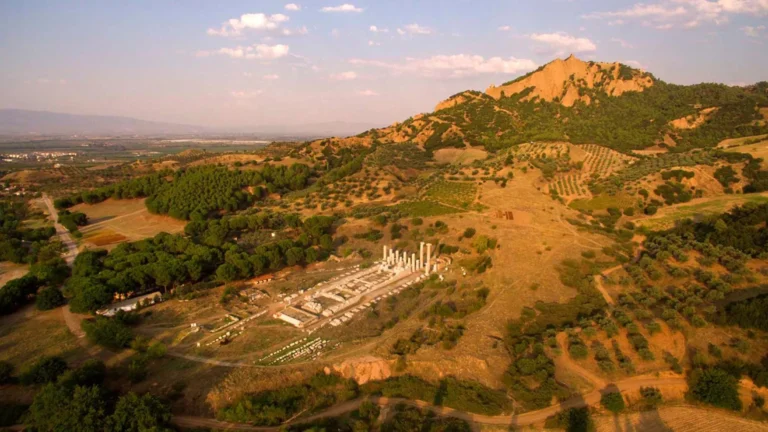
For thousands of years, the ancient city of Sardis in western Türkiye changed hands with the rise and fall of the Greeks, Romans, Byzantines and Ottomans. Yet while the city’s rulers changed frequently, one thing has remained remarkably constant. Since 1958, archaeologists have returned each year as part of the Harvard Cornell Exploration of Ancient Sardis, making it one of the world’s longest-running institutional excavation projects.
“It’s really important that there be institutional continuity,” said Benjamin Anderson, associate professor of history of arts and visual studies in the College of Arts and Sciences. “Many of us know and have been mentoring colleagues from the previous generation of excavators. As a result, this is one of the few long-term archaeological projects in the region that has generated a significant amount of data.”
For the past several years, Anderson has focused on documenting the walls and buildings of the Acropolis of Sardis, which became an important center during the Byzantine period following Roman rule.
“This is a city that reflects many ancient historical sources,” he said. “But now, over the last 75 years or so, we have the possibility to tell that story, also based on what the project has found archaeologically.”
This summer marked another milestone. Thanks to decades of excavations and support from the local community, Sardis was added to the UNESCO World Heritage List.
“The opportunity to really begin to understand a culture through physical remains is quite unusual, and it requires that kind of long-term commitment,” Anderson said. “This is what is being celebrated by the World Heritage designation by UNESCO. This project has been distinguished from the beginning by a desire to communicate the results and to make its work legible to tourists and locals and all kinds of different audiences.”
Sardis preserves thousands of years of history
Once the capital of the Iron Age kingdom of Lydia, Sardis occupied a strategic location between the Mediterranean and the Anatolian Plateau. According to Annetta Alexandridis, associate professor of history of art and classics at A&S, it served as “a place of cultural encounter between East and West.”
The Lydian era is particularly important for archaeologists and historians. The Lydians are widely credited with inventing coins, and their ruler, King Croesus, became famous for his immense wealth. Lydia was later conquered by Alexander the Great, after which Sardis became part of the Roman Empire, followed by the Byzantine and Ottoman Empires.
“Because it was not built by any modern city – it’s just a small village – Sardis gives you a long history from the Bronze Age, the third millennium BC, basically up to today,” Alexandridis said. “There are all these layers there, and sometimes it’s difficult to excavate, because they’re not clearly stratified. They interfere with each other, but, in a way, it’s a continuous history, and that’s what makes it so fascinating to us.”
As associate director of excavations, Alexandridis studies Roman funerary culture and is now leading a survey of Sardis’s cemeteries, many of which have received much less attention than the nearby Bin Tepe cemetery, located about 10 kilometers north of the city. Bin Tepe contains some of the largest tumuli (burial mounds) ever recorded.
A site that shaped archeology
Sardis also holds an important place in the history of American archaeology. The first modern excavations, led by the American Society for the Excavation of Sardis in the early 20th century, were “truly exploitative on a large scale,” Alexandridis said. Excavators explored the Temple of Artemis and the Necropolis, but many artifacts were damaged, went missing, or were taken to the United States by questionable means. One of them was a colossal column which is on display in the Metropolitan Museum of Art.
The project ended with the Greco-Turkish War in the early 1920s. Over the next decades, some artefacts were gradually returned to Turkey.
“This is one of the first cases where we can see a full discussion about the restitution of illegally exported antiquities, until some have been returned to Turkey,” Alexandridis said. “There are all these broader issues of how to deal with cultural heritage, not only from a conservation or scholarly point of view, but also from a political and legal point of view, and the question of management and responsibility for culture in the past.”
The modern Harvard Cornell partnership began in 1958 under Harvard archaeologist George M.A. Hanfman and Cornell architect Henry Detweiler of the College of Architecture, Art, and Planning, whose expertise focused on documenting historic buildings.
“If you went to Sardis in 1950 there were a few things sticking up above the ground, but nothing really worth seeing,” Anderson said. “The architects were the first generation of Cornelians to be there, and the project was really committed to responsibly taking what they had excavated, complementing it through newly constructed pieces, and presenting a total experience of the structure, rather than just making a drawing and putting it in a publication.”
During the 1950s and 1960s, the team rebuilt a vast Bath gymnasium complex and the largest synagogue in the ancient world. Those restoration efforts became an influential model for similar work at archaeological sites elsewhere.
Since then, excavations have revealed mud-brick city walls, the acropolis, a Persian period waste pit, a gold refining workshop, an ancient shopping district and, most recently, a sanctuary plaza that required 15 years of excavation.
Training the next generation of archaeologists
Today, the project is based at the Harvard Art Museums and involves researchers from Turkish institutions as well as several American universities, including the University of Wisconsin, Madison and the University of California, Berkeley. Cornell contributes primarily to graduate students, as well as a growing number of graduate students who spend 10 weeks each summer working on site.
Students either catalog the recovered artifacts, most of which are ceramics, or “broken pots”, as Anderson describes them, or supervise excavation trenches.
Since Sardis is located on an alluvial plain, some of the trenches extend up to 12 meters underground.
“[They’re] “That in itself is terrifying,” Anderson said.
“Local workers, who are already trained, slowly remove soil, and the students are there observing, documenting, taking notes, asking questions, determining when they need to stop and maybe call the director or an associate director to see what’s going on, when they should take photographs, when they should bring in architects to create a state portrait of a particular moment,” Anderson said.
According to Anderson, Sardis is one of only three excavation projects worldwide that “most people pursuing careers in classical archeology in America have gone through.”
More than half of the researchers involved today are Turkish experts and students, and local participation remains central to the success of the project.
“A theme regularly associated with what we’re doing is how are we doing it? How do we incorporate local expertise?” Alexandridis said.
Today, women from the Sardis area work alongside men in excavations and restoration efforts.
Local connection to an ancient city
Leyla Ugurer, now a doctoral student in the history of art and archaeology, grew up near Sardis. He studied English language and literature at Istanbul University before deciding to pursue classical archaeology.
“To learn archaeology, you also have to work on site,” he said.
In early 2022, they surveyed rock cut tombs from the Lydian to Roman periods around Sardis. He continued this work for three summers before returning this year to oversee the excavation of a final Roman site.
His experience at Sardis inspired him to pursue a PhD. at Cornell, where Alexandridis became his advisor. Both have an interest in funerary art, which provides insight into beliefs about beauty, the afterlife, and everyday life.
It was a city located on “one of the most important trade roads of the ancient world”, where the first coins were minted and which Alexander the Great visited, Ugurr said. “You were brought up there, so you have the same culture going on inside you and around you. I remember watching and admiring archaeologists when I was a kid. Being familiar with the archaeological work going on there helps you understand the archaeological importance more.”
He believes that UNESCO recognition would bring significant benefits to the region.
“Being a local, I can say that this is very important,” she said. “First of all, now it is known around the world and because of UNESCO, there can probably be more funding for excavations, as well as people, more tourists and more research. People will know the area better, and there will be more safety.”
Protecting Sardis for the Future
There is a desperate need for more security. The landscape of Sardis is vulnerable to natural erosion, while many of the tumuli have already been damaged due to farming. Looting has also become a serious problem.
Alexandridis said treasure hunters now operate on an “industrial dimension” scale, using explosives, bulldozers and often weapons to target ancient burial mounds.
Even after nearly seven decades of continuous excavation, researchers say there is still much to discover at Sardis.
“That’s why a long-term commitment is so important,” Anderson said. “A season’s work, you’ll learn how to do the job, but you won’t necessarily find something that’s particularly important to the history of the site, until maybe 10 years later you find something a little further away and the pieces start to connect.”