
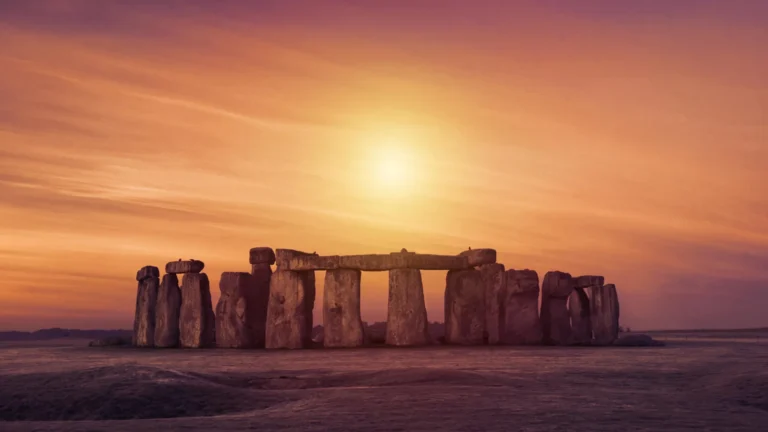
A new study led by researchers at Curtin University provides fresh insight into one of Stonehenge’s most enduring mysteries: how a giant stone made its way to Britain to become part of the famous monument.
The focus of the research is the Altar Stone, a six-ton sandstone megalith located at the center of Stonehenge. Previous work has shown that the stone originated in northeastern Scotland, about 700 kilometers (435 mi) from Salisbury Plain, making its presence at Stonehenge one of the most remarkable examples of long-distance transport in prehistoric Europe.
The latest findings strengthen the idea that ancient people, not natural forces, were responsible for moving the giant stone across challenging terrain.
Tracing the Ancient Journey of the Altar Stone
The study builds on earlier research that had ruled out glaciers as the primary means of transporting stone. To investigate further, scientists combined mineral grain dating techniques with computer models of ancient ice sheets. Their goal was to determine where the stone came from and whether glaciers could have carried it southward during the last ice age.
According to the results, glaciers may have moved rocks through Scotland, possibly reaching the Dogger Bank in what is now the North Sea. However, models show that there was no realistic glacial route that could have delivered the Altar Stone directly to southern England.
This leaves a significant portion of the journey unexplained by natural processes alone.
Evidence points to human transport
Dr Anthony Clark, co-lead author of the Timescales of Mineral Systems group within the Curtin School of Earth and Planetary Sciences, said the evidence indicates the stone’s movement was deliberate rather than accidental.
“Rather than being transported naturally by the ice, the evidence points to deliberate, carefully planned movement across a challenging and diverse landscape,” Dr Clark said.
“Our modeling shows that glaciers would have moved rocks part of the way during the last ice age – possibly as far as Dogger Bank in the North Sea – but not in southern England, meaning the stones would still need to be transported hundreds of kilometers by people.
“The research indicates that there was no viable glacial route directly connecting the source area to Stonehenge, which strengthens the conclusion that human transport was required.
“Instead, it suggests that the stone was probably transported in stages, potentially combining land carriage with river or coastal transport where possible.”
A remarkable achievement of Neolithic organization
Moving a six-ton stone over such a great distance must have been a huge task for Neolithic communities. Researchers believe the journey would likely involve several stages and require careful coordination between groups living in different areas.
Dr Clark said the findings highlight a level of planning and collaboration that may be far greater than previously recognized.
Dr Clark said, “Moving a stone of this size over such a long distance would have required planning, coordination and a deep understanding of the landscape – not to mention tremendous determination.”
“The study demonstrates how combining geological analysis with computer modeling can help resolve long-standing questions about how Stonehenge was formed.”
Researchers plan to continue investigating the origins of the Altar Stone by identifying its exact source location in northeastern Scotland and exploring the routes prehistoric people used to transport it.
The study involved a collaboration between researchers from Curtin University, Sheffield Hallam University, the University of Sheffield, Wessex Archeology and the University of Bristol.